
Features of Lollipop Equipment
Lollipop Equipment refers to specialized machinery used in lollipop production, including candy cooking, depositing, stick insertion, cooling, demolding, and packaging. Different types of Lollipop Equipment offer different functions, but modern machines generally focus on high efficiency, precise temperature control, flexible mold options, food safety, and automated operation.
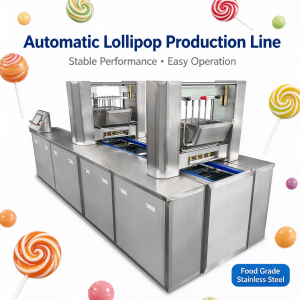
1. High Efficiency and Automation
One of the main advantages of Lollipop Equipment is its high production efficiency. Automatic production lines can operate continuously and produce thousands or even tens of thousands of lollipops per hour, depending on the machine model and product specifications.
- Integrated Production Process: Combines sugar melting, candy depositing, stick insertion, cooling, demolding, and packaging.
- Reduced Labor Costs: Automation reduces manual intervention and improves production consistency.
- Stable Production Capacity: Suitable for medium-sized and large-scale confectionery manufacturers.
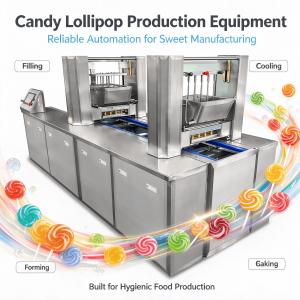
2. Precise Temperature Control System
Precise temperature control is essential for producing high-quality lollipops. Professional Lollipop Equipment maintains stable syrup temperatures throughout the cooking and depositing processes, helping prevent sugar crystallization, overheating, and inconsistent candy quality.
- Accurate Sugar Cooking: Temperature settings are adjusted according to the candy formulation and production process.
- Efficient Cooling System: Cooling channels in the molds help the candy solidify quickly.
- Consistent Product Quality: Helps maintain the desired transparency, gloss, hardness, and shape of the finished lollipops.
3. Flexible Mold Options for Different Shapes
Modern Lollipop Equipment supports interchangeable molds, allowing manufacturers to produce lollipops in various shapes, sizes, and designs.
- Multiple Shapes: Round, heart-shaped, cartoon-shaped, and customized lollipops.
- Customized Mold Designs: Suitable for different market demands and brand requirements.
- Durable Materials: Food-contact components are selected according to applicable food safety requirements and operating conditions.
- Easy Demolding: Proper mold design helps improve production efficiency and maintain the appearance of finished products.
4. Hygienic Design and Operational Safety
Food safety is a key consideration when selecting Lollipop Equipment. Machines designed for commercial candy production use suitable food-contact materials and structures that facilitate cleaning and maintenance.
- Food-Grade Materials: Stainless steel, including 304 stainless steel where appropriate, can be used for food-contact parts.
- Easy Cleaning: Smooth surfaces and accessible components help reduce cleaning time and simplify routine maintenance.
- Operational Safety: Protective guards, emergency stops, and other safety features can be incorporated according to the machine design.
- Compliance Considerations: Materials and machine configurations should meet the applicable food safety and machinery requirements in the destination market.
5. Flexible Customization Options
Another important advantage of Lollipop Equipment is its ability to accommodate different product requirements and production plans.
- Multiple Colors and Flavors: Optional depositing systems can support multicolor or layered lollipop production, depending on the configuration.
- Customized Candy Shapes: Mold designs can be tailored to specific product concepts.
- Filling Options: Specialized configurations may support filled or center-filled lollipops.
- Packaging Integration: Compatible packaging machines can be connected to support twist wrapping, individual packaging, labeling, or gift-box packaging.
These options help confectionery manufacturers expand their product range and respond to changing consumer preferences.
6. Intelligent Control System
Modern Lollipop Equipment can be equipped with a PLC control system and a touchscreen interface, making production easier to manage.
- Digital Parameter Adjustment: Operators can adjust production speed, depositing volume, and temperature according to the machine configuration.
- Recipe Management: Selected models allow operators to save and recall production parameters for different products.
- Fault Alarms: The control system can provide alerts for certain operating abnormalities, such as temperature deviations or equipment faults.
- Improved Production Management: Automated control helps reduce operating errors and maintain consistent production conditions.
7. Small-Scale and Commercial Lollipop Equipment
Different types of lollipop machines are available for different production needs.
Small-Scale Equipment
- Compact design for small businesses, candy shops, and confectionery workshops.
- Manual or semi-automatic operation.
- Lower initial investment and relatively limited production capacity.
- Suitable for customized products, product development, and small-batch production.
Industrial Lollipop Equipment
- Designed for continuous commercial production.
- Higher output and greater automation.
- Can be integrated with cooking, depositing, cooling, and packaging systems.
- Suitable for confectionery factories and manufacturers serving wholesale markets.
Actual production capacity depends on the machine model, lollipop size, mold configuration, cooling time, and level of automation.
8. Applications of Lollipop Equipment
Lollipop Equipment is widely used in different confectionery production environments.
- Confectionery Factories: For standardized, large-scale lollipop manufacturing.
- Small Candy Manufacturers: For small-batch production and business expansion.
- Customized Candy Workshops: For creative shapes, special colors, and branded products.
- Candy Packaging Facilities: For integrating lollipop production with downstream packaging operations.
Conclusion
Choosing the right Lollipop Equipment can help candy manufacturers improve production efficiency, maintain consistent product quality, reduce labor requirements, and expand their product range. When selecting a machine, buyers should consider production capacity, lollipop shapes, mold requirements, automation level, temperature control, cleaning convenience, and compatibility with packaging equipment.
Whether you operate a small confectionery business or a large candy factory, selecting suitable Lollipop Equipment according to your production requirements is an important step toward achieving efficient and reliable lollipop manufacturing.